
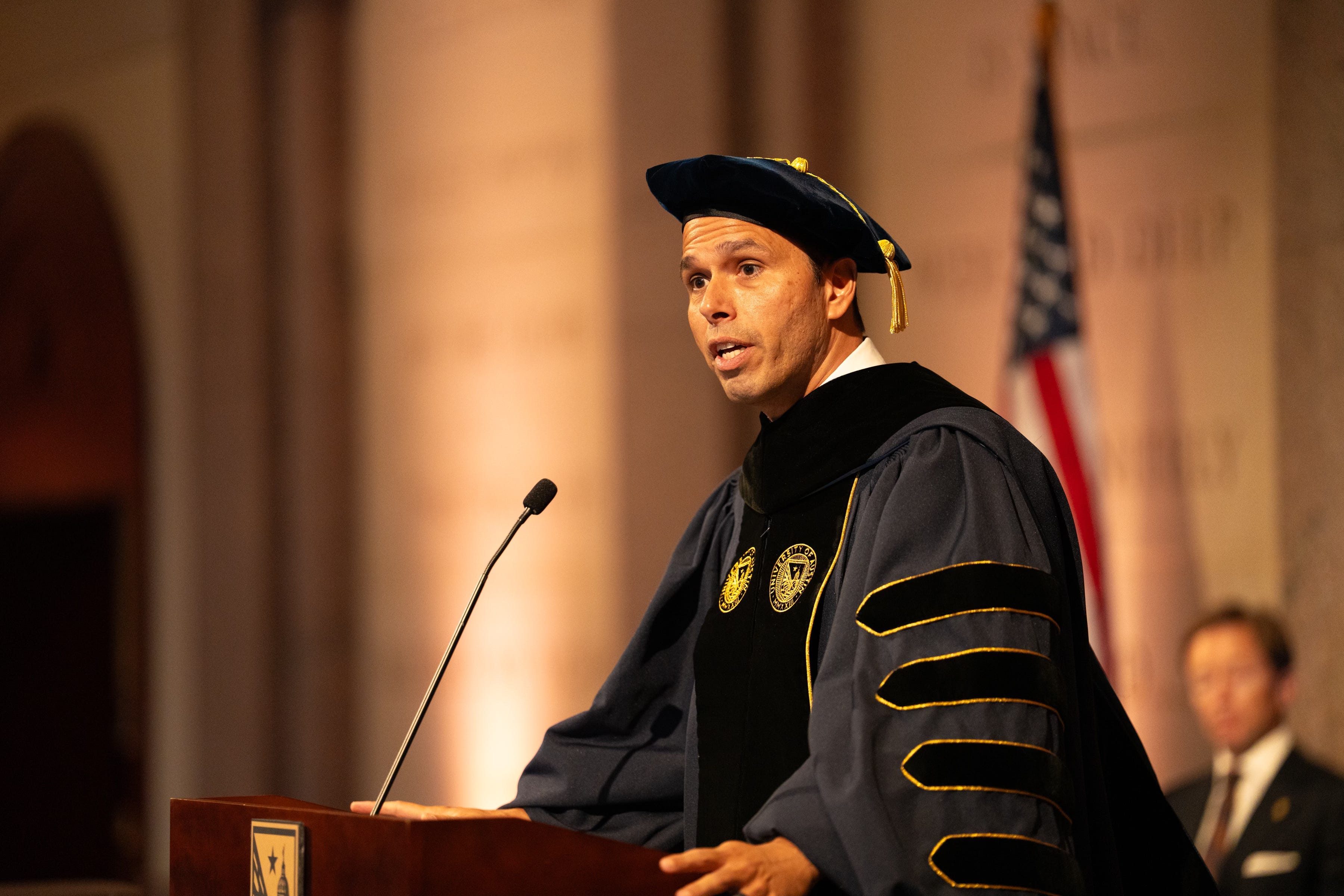
Carlos Carvalho, President of the University of Austin (UATX), recently told me, “UATX is Navy Seals training for the mind”. It’s no surprise, then, that when I ask 19-year-old UATX student Merrick Meardon difficult philosophical questions, he was more than capable of sustaining a high level of discourse about concepts of “abiding significance”. (Hat tip to the late philosopher Dan Dennett who popularized this phrase.)

Merrick and I didn’t know what we’d talk about when we sat down together, but we both knew the unspoken assumptions: You will be held to task for your ideas; our conversation will likely not be intellectually easy; if I detect a mistake in your reasoning you’ll know about it, and I expect the same courtesy from you; there are no limits on the content or how deep the conversation will go. Merrick attends the University of Austin, and that’s the normative expectation.
I never could have had such a conversation at 19. Not only in terms of content, but also how Merrick effortlessly juggled ideas and handled pushback. I found Merrick’s view of meaning, purpose, and what makes a good life to be fresh, honest, and compelling. I have unshakeable confidence in his ability not just to professionally and personally succeed but to thrive.
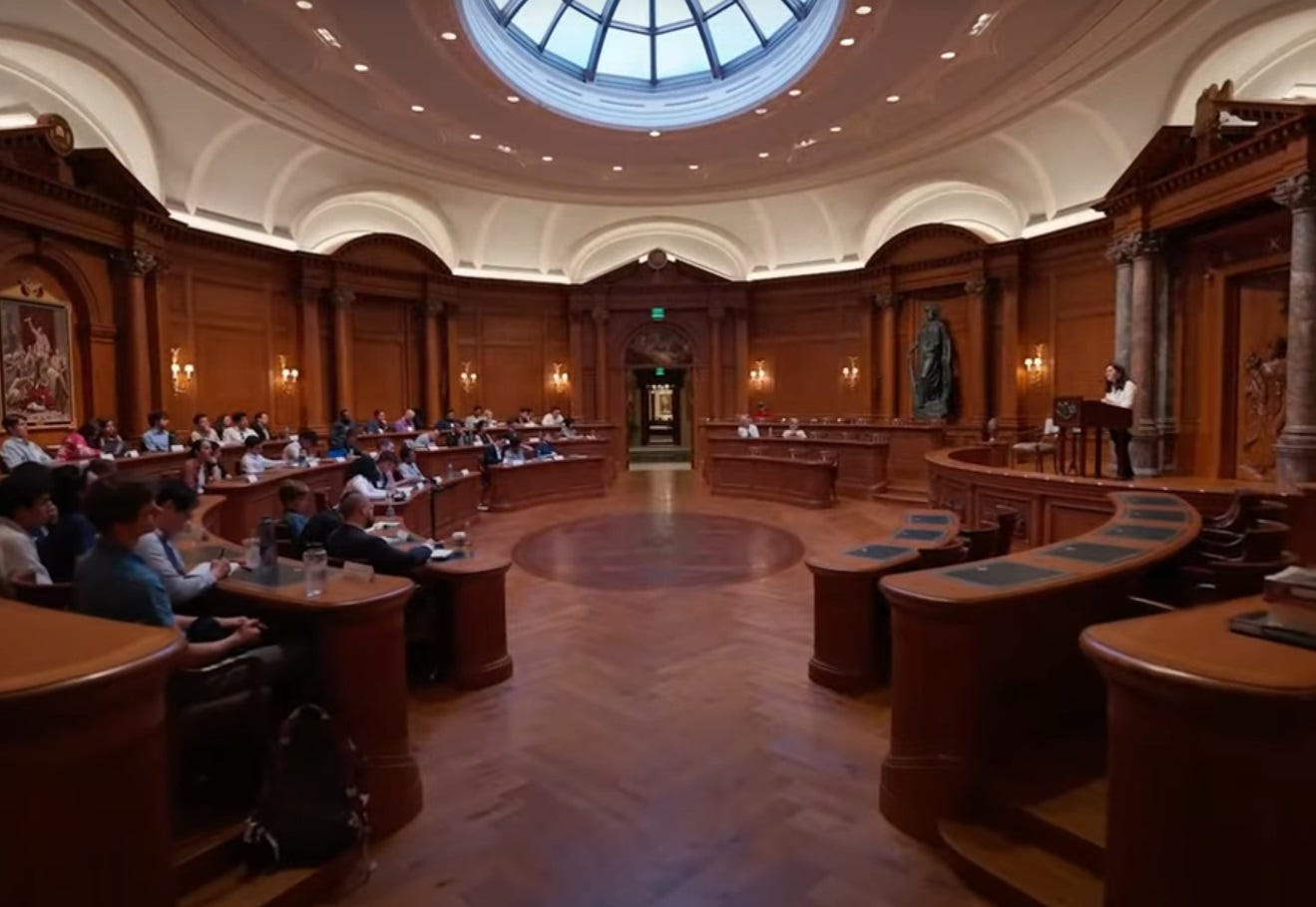
University of Austin
Our commitment to the pursuit of truth arises from our confidence that the nature of reality can be discerned, albeit incompletely, by those who seek to understand it, and from our belief that the quest to know, though unending, is an ennobling, liberating, and productive endeavor.
As an academic community, UATX values both the wisdom of the past and the transformative potential of novel ideas. The University is dedicated to the preservation and transmission of humanity’s rich intellectual, scientific, artistic, and cultural inheritance. At the same time, UATX vigorously pursues the discovery, creation, and communication of new knowledge.
Each of these endeavors depends on our fostering an environment of intellectual freedom and pluralism. UATX strives to build and sustain a community based on the lively clash of ideas and opinions.
My work in helping UATX get off the ground, and my continued engagement, is without doubt among the proudest and most significant of my career. UATX’s mission statement says it all: The University of Austin prepares thoughtful and ethical innovators, builders, leaders, public servants and citizens through open inquiry and civil discourse. In an age when open inquiry and civil discourse is under attack from the rightwing, leftwing, and even those with no wings, UATX is an educational oasis. We truly are creating intellectual navy seals.
Application
“At University of Austin, your merit earns you undergraduate admission—and free tuition.”
Applications take 5 minutes and are merit-based.
Here’s what you need: If you scored 1460+ SAT, 33+ ACT, or 105+ CLT, you are automatically admitted.
Nothing else matters. Your race is irrelevant. Your indigeneity status is irrelevant. You speak 10 languages fluently? Irrelevant. You feel like you were born in the wrong body? Irrelevant. You’ve won five Nobel Prizes? Irrelevant. Your parents are rich and friendly with Joe Lonsdale and Niall Ferguson? Irrelevant. You received 1460+ on your SAT? Congratulations, you’ve automatically qualified for navy seals training of the mind. (NB Spots are limited/first-come-first-served.)
It’s that simple.
If you’ve got what it takes, apply. Tuition is free and it will change your life.
Here are two Spectrum Street Epistemology sessions from UATX:
Below, please find Merrick’s guest Substack post.
Saving Creativity in AI Land
I started as a freshman at the new University of Austin just before AI cheating came to be expected. As expectations changed – as the use of AI to read for you, to write for you, became presumably irresistible – my professors adapted. At first they assigned more challenging essays and lengthier readings to raise the intensity of their courses. The idea was that AI cheating on harder work would be more easily detectable. Before long they dropped that idea. Not just in college courses but in the whole sphere of knowledge, information, and art, the plausibility of AI forgeries had become so great as to cast doubt on any written assignment. By the end of my freshman year, professors were forced to acknowledge that it had become too difficult to distinguish between authentic student work and ChatGPT.
Most University of Austin students want their college work to mean something and to cultivate their own creativity. They responded enthusiastically to Niall Fergusson’s speech, given towards the end of the last academic year, in which he offered a vision for the university as a “cloister” where people with a common devotion to authentic knowledge, to learning true things from the minds of the past and the present, could voluntarily lock themselves away from all the counterfeit information trying to pass itself off as human thought. Outside of the cloister one could do as he pleased, but entering into it, would be subject to strict regulations: no AI and maybe even no phones, no laptops on campus. This would make it possible for people, anyone inside the cloister, to write with credibility again. One would not need to doubt that a piece of writing was real if it came from a closed environment in which the tools of falsification are banned by mutual consent.
When we returned in the fall, the University of Austin decided to adopt a different approach. It had taken more practical measures to prevent students from using AI which involved changing the nature of assignments and evaluations. Essays were done away with except as a couple of timed exam questions. They were replaced with daily reading quizzes. This forced students to concentrate on the text rather than generate summaries, offering no opportunity to hand in AI writing. It also meant that they were hardly ever asked to come up with ideas to be expressed creatively in carefully thought-out writing. The University plans to bring back paper-writing now that students have been conditioned to the new degree of self-reliance and rigor, but it seems unavoidable that the doubts which ruined the trust between writer and reader, teacher and student, and student and student would return. Real creativity will die away because nobody can trust that it’s real.
There are plenty of ways in which AI can be used to reduce drudgery and improve skills. It can allow me to track down a chapter that I only vaguely remember in order to support an argument that is entirely my own, for instance. But when I do that, I am contributing to a great machine that will also be used to generate material that will make my argument or creation indistinguishable from one that is devoid of any human ingenuity. Even when I use AI creatively, I am participating in the system that will drown that effort in effortless fakes and tell me I shouldn’t have bothered using its tools for creative ends. It can do that itself. AI is a tool that may be used for human creativity but will certainly be used in a way that tears up the foundation of that creativity. The benefits are overwhelmed by its inevitable outcome.
The destruction of creativity extends far beyond the doors of any college campus. Anything that is written, drawn, advised, or made may be inauthentic, created by LLMs, without the need for creative activity from a human. Writers and artists who are afraid that life would be uninteresting if stripped of credible creativity may have to forget about any audience for some time. If the only one who knows the credibility of the work is its author, he will have to create it only for himself. Then, if anyone else wishes to place his faith in that artist’s creativity and to have his creativity appreciated in turn, both parties would have to agree to a set of cloistered rules that ban outright the machines that cast doubt on creativity. These circles could expand, but they could not relax their policy and would have to limit their mixing with the outside world as much as possible. With AI everywhere and in everything, there has to be some place where it is entirely absent in order for creativity to exist. That place could be as small as the mind of one person; ideally, enough people care about the accomplishments of the real, unassisted human intellect that they will bind together and reject the technologies that would otherwise make human creativity obsolete.
People who don’t care whether they are reading something written by a human being or a computer or let AI help them to express themselves do not realize that when they buy into the AI simulations of human thought, human artistry, and human companionship, all the things that should provide meaning and beauty to our lives are at stake. If you cannot be certain that the thoughts entering your mind and stirring your emotions come from a real source of meaning – whether that source is human creativity, social life, the natural world, or God – the sense of living in this world disappears. AI infringes on the security we can have in the more beautiful and original springs of meaning in the universe by telling us that a false version that looks similar enough is just as good. Someone who believes that his life will be just as meaningful if he watches AI movies, reads AI books, loves an AI girlfriend, and worships an AI god must at least recognize that the people who need these things to be real in order for them to be meaningful will have a harder and harder time knowing whether the ideas to which they devote their time are meaningful ones or fakes. Constantly surrounded by falsified copies of the real meanings to their existences, their only hope is to separate themselves from the world of confusion.
My university education involved lectures from experts followed by 1) reading an important work referenced in the expertise, 2) asking an important question of the reading, 3) explaining in written form why the question was important, and 4) taking turns presenting the question and why it was important to a group of fellow students in seminar to critique and follow up. It didn't take long for me to realize that every student no matter what diverse identities and affiliations they 'represented', no matter the age, no matter the prior education, all offered unique contributions to my own thinking. This is where I discovered that someone who fully agrees adds nothing. But great value comes from those who disagree for cause. I have since become quite disagreeable to a great number of friends, family, and acquaintances. I won't know how this works out until I'm dead and then they can talk amongst themselves.
"open inquiry and civil discourse is under attack from the rightwing, leftwing. . ." REALLY?? Anyone cogent and paying attention is SICK of such ridiculous self-defeating both-sidesism! Such attack is characteristic of ONE side, and ONLY ONE side. If there's any at all, .05% of the attack, coming from the other side it's certainly not easy to see!