
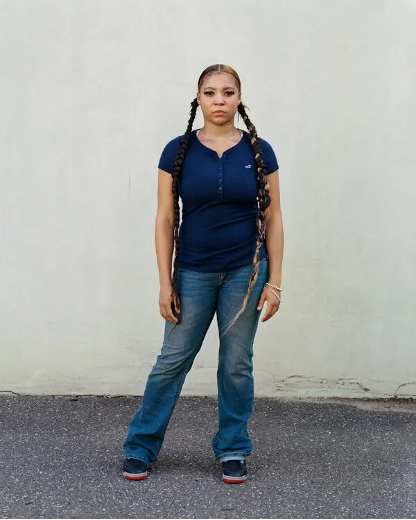
“So you had money to send me to one of the best schools, and you chose not to? Because other kids are disadvantaged, you didn’t want to put me in a great school?” … “Sometimes I wish instead of always thinking about other kids, you would have thought about me.” – Najya Hannah-Jones
Nikole Hannah-Jones, best known for creating The 1619 Project, concedes harm to her child yet still will not retire the ideology that caused the harm. Kudos to Jones, given her large platform, for admitting in the New York Times Magazine that she made a mistake and harmed her child. That deserves credit.
Jones published a remarkable piece in the New York Times Magazine, “In Fighting for Every Black Child, Did I Betray My Own?” A decade ago, she sent Najya to a high-poverty, mostly black Brooklyn school so the family would not “be part of the problem.” Weak teaching and low standards produced inflated grades and major educational gaps. Najya later chose a demanding high school and needed remedial tutoring. Jones now says she “failed both my values and my child.”
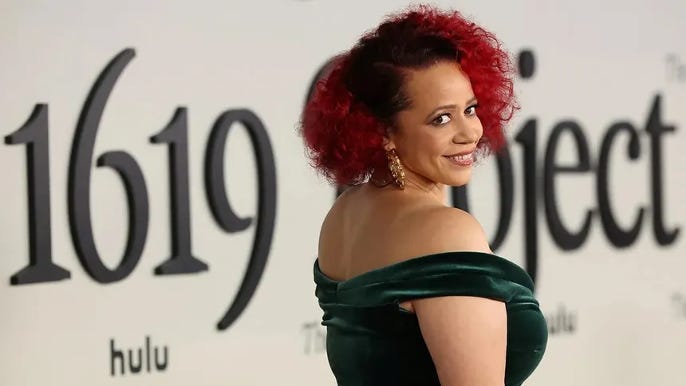
One reason Jones’ essay is interesting is that her politics are explicitly race-conscious. Her work treats race as the master category of American life. She centers black historical experience as the nation’s origin story and presses for race-specific remedies rather than race-neutral liberalism.
Before reading the piece, I was skeptical, thinking that she would not sincerely question any of her core assumptions. Jones does question the cost, but she does not rethink the cause. She treated a statistical child as more morally urgent than the child in her house. She will admit what that ranking cost Najya. She will not admit the ranking was wrong.
Jones’ piece is also interesting on two other fronts: 1) She has an archetypically leftist disposition in the sense of valuing the lives of people far away at the direct expense of the lives of the people right next to her (in this instance, her daughter); 2) She has an archetypically conservative disposition in that her understanding of community is what she owes to others as opposed to what others owe to her. She actually acted on this disposition and sacrificed the success of her own child for that cause. (COVID maskers exemplify the archetypical left-wing disposition of “preoccupied with what others owe to you.” They’re often enraged that people don’t mask and social distance for them.)
Poor, Black, Segregated
This paragraph is striking:
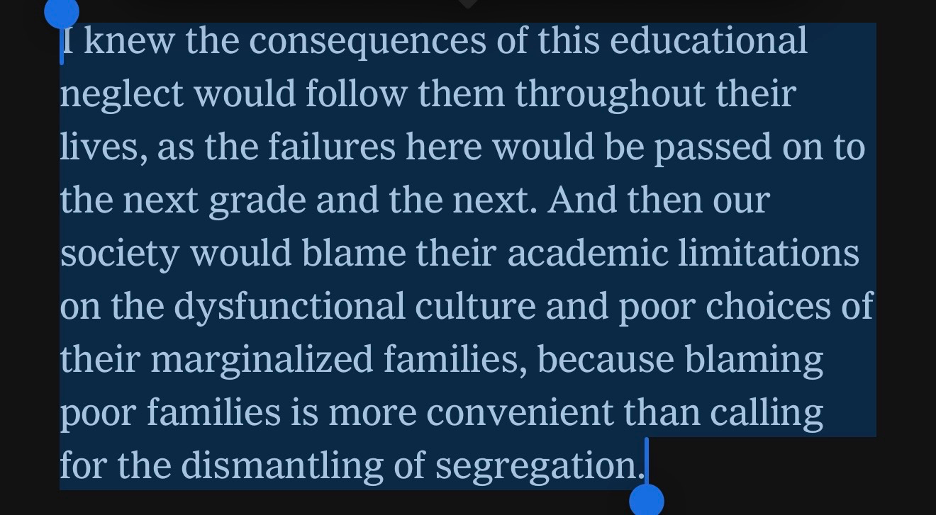
Jones treats “poor and black” as if poverty were the mechanism. It is not sufficient. Poor white and poor Asian students outscore poor black students by a wide margin. Higher-SES black students often land near lower-SES white students. Money explains part of the gap. It doesn’t explain the rest.
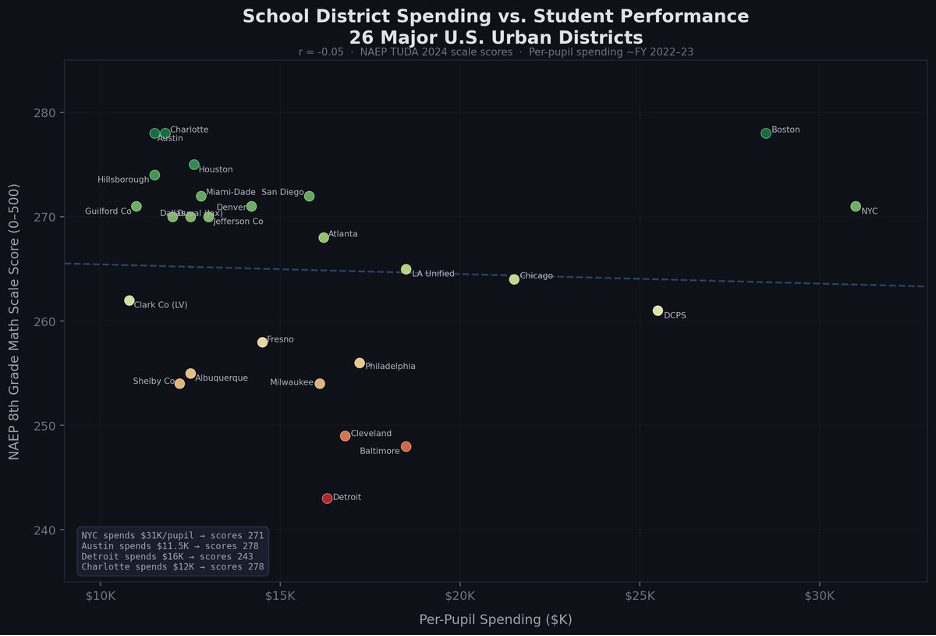
District spending vs. performance: Raw correlation near zero. If funding were what Najya’s school lacked, district spending would track performance.
Source:


Jones believes we’ll blame dysfunctional culture and poor choices, while she takes it for granted that the reader will agree that this is the wrong thing to blame. But throughout the piece she cites exactly that: Parents who choose not to engage with schools and who do not discipline their children.
Another point she misses is that while she consistently correlates wealth with teaching quality, when you examine the examples she cites of poor teaching quality in poor schools, there is very little connection between the two (wealth and poor teaching). Instead, it’s poor instruction and staff who don’t care and are checked out.
Finally, the argument that we need to desegregate black schools to make them successful is contributing to the very thing she’s waging war against: Racism. Jones writes as if a black school cannot succeed until enrollment racial demographics change. Why do black schools need white and Asian people to be successful? But that’s exactly the argument Jones makes. (For two examples of schools that are almost exclusively minority, and successful, see Ian Rowe’s Vertex Partnership Academies in the Bronx and Katharine Birbalsingh’s Michaela in London.)
What Jones does not do is shed the ideology that produced the harm. She still reads the wreckage as proof that segregated schools are the problem. Her ideology required a sacrificial child. The child noticed. The ideology did not.
Peter
References
Paschall, K. W., Gershoff, E. T., & Kuhfeld, M. (2018). A two decade examination of historical race/ethnicity disparities in academic achievement by poverty status. Journal of Youth and Adolescence, 47(6), 1164–1177. https://doi.org/10.1007/s10964-017-0800-7
Coffey, M., & Tyner, A. (2023). Excellence gaps by race and socioeconomic status. Thomas B. Fordham Institute. https://fordhaminstitute.org/national/research/excellence-gaps-race-and-socioeconomic-status
